Toronto is Canada's largest city and one of the most ethnically diverse urban centres on the planet — roughly half of its residents were born outside the country, and that statistic shapes everything from the food scene to the neighbourhoods to the cultural calendar. It sits on the north shore of Lake Ontario, spreads across a vast grid of low-rise and high-rise neighbourhoods, and anchors a metropolitan region of over six million people. First-time visitors are often surprised by how walkable the downtown core is, how quickly the lake appears at the end of a southbound street, and how the city resists easy summary.
The CN Tower is the obvious landmark and worth visiting once, but Toronto's real appeal lies in its neighbourhoods: Kensington Market's chaotic mix of vintage shops and Caribbean bakeries, the Distillery District's Victorian industrial architecture, the hushed rooms of the ROM, the Saturday morning energy of St. Lawrence Market. Give the city at least three days and plan around what interests you rather than ticking landmarks.
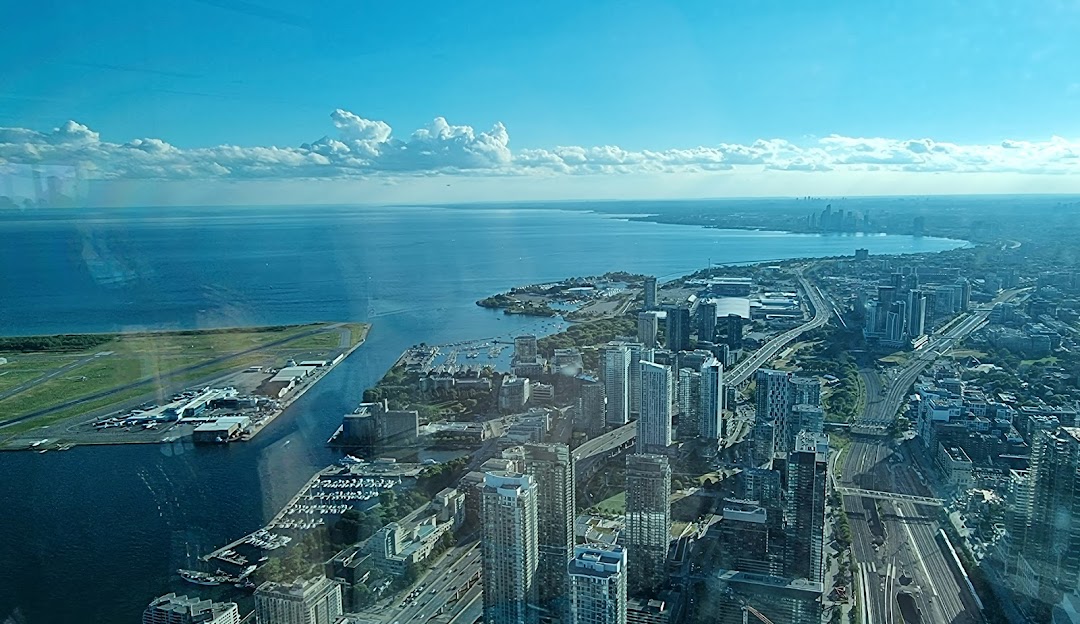
CN Tower
Standing 553 metres above the city, the CN Tower held the record as the world's tallest free-standing structure for over three decades after its completion in 1976. The glass-floor observation deck at 342 metres is the standard visit; the LookOut level just below has floor-to-ceiling windows and a rotating restaurant. The EdgeWalk — a hands-free walk along a 1.5-metre-wide ledge on the outside of the main pod, 356 metres up — runs from May through October and requires advance booking. It's genuinely terrifying in the best possible way.
Buy tickets online in advance to skip the queues at the base. The SkyPod at 447 metres costs extra and has smaller windows; most visitors find the main observation deck sufficient. Evening visits give you the city lights and, on clear nights, the glow of Niagara Falls on the horizon to the south.

Royal Ontario Museum
The ROM holds one of the largest natural history and world culture collections in North America, with over six million objects spread across 40 galleries. The Michael Lee-Chin Crystal — architect Daniel Libeskind's jagged glass and aluminium addition bolted onto the original 1914 Edwardian building — is either a masterwork of contemporary architecture or a collision with the original building, depending on your view. Inside, the dinosaur gallery on the third floor is consistently the most popular room, and deservedly so: the specimens are well-lit and the casts are accompanied by enough context to make the scale legible.
The ancient Egypt gallery, the East Asian collection, and the First Peoples gallery are all worth serious time. Budget two to three hours minimum. General admission is around $30; first Tuesdays of the month offer reduced rates. The ROM is at Bloor and Avenue Road, on the Bloor-Danforth subway line.

Kensington Market
Kensington Market is not a market in the conventional sense — there's no single building or organised vendors — but rather a neighbourhood of roughly six city blocks west of Spadina Avenue that has accumulated decades of independent shops, cafes, vintage clothing stores, fishmongers, cheese shops, and restaurants in a compressed and slightly chaotic grid. It feels nothing like the rest of downtown Toronto, which is part of its appeal. The streets are narrow, the buildings are two and three storeys, and the mix of uses changes block by block.
Saturday mornings are when the neighbourhood is most alive. The Rasta Pasta on Augusta Avenue, the Caribbean takeaways on Baldwin Street, the Portuguese custard tarts from the bakeries — there's no curated food tour that captures it as well as just wandering. The neighbourhood also hosts monthly Pedestrian Sundays from May through October, when the streets are closed to cars.

Distillery District
The Distillery District occupies the preserved Victorian industrial complex of the Gooderham and Worts Distillery, which operated from 1832 until 1990 and was at one point the largest distillery in the British Empire. The redbrick buildings, cobblestone lanes, and heavy wooden beams have been converted into galleries, restaurants, boutiques, and theatres — a well-preserved example of adaptive industrial heritage that manages to feel like a real neighbourhood rather than a themed development.
The Trinity Street corridor is the main pedestrian spine. Young People's Theatre and the Soulpepper Theatre Company perform year-round. The Christmas Market, which runs through December, is one of the most atmospheric seasonal events in the city. Balzac's Coffee has a location here in a particularly beautiful Victorian space.

Toronto Islands
The Toronto Islands are a chain of small islands and sandbars in Lake Ontario, just ten minutes by ferry from the foot of Bay Street. They're car-free, mostly flat, and offer the best views of the Toronto skyline available anywhere — the perspective from Centre Island looking north at the financial district towers over the water is one of those compositions that works in every season and every light condition. The islands cover about 820 acres and include beaches, picnic areas, an amusement park (Centreville, aimed at young children), a small farm, and a functioning neighbourhood of about 250 houses on Ward's Island.
The beaches on the south side of Centre Island and Hanlan's Point face the lake and can be genuinely swimmable in July and August. Hanlan's Point Beach has a designated clothing-optional section. Bike rentals are available on Centre Island. The ferry runs from the Jack Layton Ferry Terminal at Bay Street, and lineups can be substantial on summer weekends — arrive early or take the first afternoon sailing.

Scarborough Bluffs
The Scarborough Bluffs are a series of sedimentary cliffs rising up to 90 metres above Lake Ontario along the eastern waterfront of Toronto. The exposed face contains roughly 12,000 years of geological layering deposited after the last ice age — silts, clays, sands, and gravels stacked in horizontal bands visible from the beach below. The cliffs themselves are actively eroding, which creates interesting formations at the base and means the top edge retreats slightly each year.
There are two distinct ways to experience the Bluffs. Bluffer's Park at the base provides a beach, a small boat marina, and the view looking back up at the cliffs from the water's edge. Cathedral Bluffs Park and Scarborough Bluffs Park at the top offer the elevated view looking down and across the lake. The walk between the two requires a steep trail. The area is in Scarborough, accessible by the Kingston Road bus from the subway.

St. Lawrence Market
St. Lawrence Market has been operating in various forms since 1803, making it one of the oldest continuously operating markets in Canada. The South Market building — an 1850 structure expanded and renovated several times — houses over 120 vendors on weekdays and Saturdays selling meat, seafood, cheese, baked goods, prepared food, and specialty groceries. The Saturday farmers' market sets up in the North Market building across Front Street and draws some of the best small producers from within a few hours' drive.
The peameal bacon sandwich from Carousel Bakery (a cured pork loin rolled in cornmeal, served on a kaiser) is the single most discussed item at the market, for good reason. The lower level has an art gallery and rotating exhibits about the market's history in the original building. The market is at Front Street and Jarvis, a short walk from Union Station.

Casa Loma
Casa Loma is a genuine Gothic Revival castle built between 1911 and 1914 by Sir Henry Pellatt, a financier who had made a fortune in electricity utilities. It has 98 rooms, towers, stables, a 800-metre underground tunnel connecting the main house to the carriage house, and views over the city from the south-facing towers that are some of the best available from a fixed elevated point. Pellatt lived there for just ten years before tax debts and the collapse of his fortune forced him out.
The self-guided audio tour takes about 90 minutes and covers the major rooms including the Great Hall, the ornate library, and the tower climbs. The stables are architecturally interesting in their own right — Spanish tile, mahogany stalls, and a skylit interior. The castle hosts events year-round including a popular haunted house at Halloween. It's in the Annex neighbourhood, accessible by subway to Dupont station.
High Park
High Park is Toronto's largest public park, covering 161 hectares of mixed landscape in the west end of the city. It contains formal gardens, a zoo with bison and deer that is free to enter, a large natural pond, tennis courts, a swimming pool, sports fields, and — most significantly — a remnant of the black oak savanna ecosystem that once covered much of southwestern Ontario. The oak savanna section in the centre and south of the park is one of the best examples of this rare plant community remaining in the province.
The park is famous for its cherry blossoms, which typically peak in late April and draw large crowds. The High Park Amphitheatre hosts free Shakespeare performances in summer. Grenadier Pond along the west edge is a good place for bird watching year-round. The park is directly on the Bloor-Danforth subway line at High Park station.
Art Gallery of Ontario
The AGO holds a collection of over 95,000 works spanning five centuries, including one of the strongest collections of European old masters outside Europe, a significant Group of Seven holding, and an important collection of contemporary African art. The building itself was redesigned by Frank Gehry — who grew up in Toronto — and completed in 2008. The Walker Court atrium and the Galleria Italia, a long gallery with a curved Douglas fir ceiling facing onto Dundas Street, are architectural spaces worth seeing independent of the art.
The Thomson Collection of European art on the fourth floor is a particular strength, including works by Rubens, Hals, and Reynolds acquired from collector Ken Thomson. Wednesday evenings are free for visitors under 25. The AGO is on Dundas Street West at McCaul, in the Art and Design District near Kensington Market.
Getting to Toronto
Toronto is served by Pearson International Airport (YYZ), approximately 30 kilometres northwest of downtown. The UP Express train connects Pearson to Union Station in 25 minutes and is the most convenient option. Taxis and rideshares take 30-60 minutes depending on traffic. Billy Bishop Airport (YTZ) on the Toronto Islands handles regional flights and is connected to downtown by a pedestrian tunnel.
Share your Toronto experience
Powered by TravelGuide Comments — share your thoughts on each attraction above.